

Considered to be the first component of the digestive system, teeth help us to crush and tear food into more digestible pieces before swallowing. As such, it’s important to understand what teeth are and how to best take care of them. If you want to smile healthy throughout most of your life, proper tooth care and visiting the dentist regularly will help you to avoid future problems. Like other healthcare with the human body, proper attention and care will keep your mouth healthier.
Contrary to popular belief and normal discussions around teeth, they are not actually bones. Although, they do have quite a few similarities to them. Similar to bones, teeth are made of multiple layers of both hard and soft tissue. Enamel, dentin, and cementum make up the harder exterior layers of the tooth, whereas pulp makes up the softer, interior layer. Blood vessels fill the interior of the tooth throughout the pulp and into the roots of your teeth, keeping teeth living and healthy.
The outermost layer is your enamel, made of minerals like calcium phosphate. Although bones have calcium phosphate in them, the enamel of your teeth is actually stronger than your bones. Unlike bones and even the innermost layers of your teeth, your enamel doesn’t contain any living tissues. However, tooth decay can still occur on your enamel. Once it has been eroded over time from things like sugary snacks, it can no longer serve its purpose of protecting the vulnerable dentin underneath.
The softer dentin underneath, because it has living tissue, is susceptible to bacteria and that leads to cavities and infection. This is why proper dental service, fluoride toothpaste, and more are recommended, because healthy teeth means your dentin stays better protected. The dentin is closer to bone in makeup than enamel.
The layer under the dentin is your cementum. The cementum’s job is to protect the root of your tooth, attaching it to the bone surrounding the tooth. It’s made of type 1 collagen (a protein found in the structure of bones) and protein polysaccharides, making it also more similar in structure to your bones.
The innermost layer of your tooth is the tooth pulp. The pulp is a soft tissue section that has connective tissue, nerve, and blood vessels that keep the tooth alive and healthy.
The biggest difference here is that when bones break, because they are entirely made of living tissue, they immediately start to heal themselves (although they still might need help with realignment, repair, etc). The enamel on teeth, however (as discussed above), don’t have living tissue, meaning it cannot repair itself like bone can. So, this is where a dentist comes in to help with crowns, implants, and more.
As we grow older, we all learn the pain that comes with losing baby teeth and having adult teeth come in. But, are they structurally different in any way? The simple answer to this is that, while baby teeth may have a smaller layer of dentin on them compared to our adult teeth, they are fundamentally the same with almost no differences between them.
Our deciduous teeth (also called baby teeth or primary teeth) serve the same function, but are replaced by permanent teeth (also called adult teeth) as our jawlines grow. Adult teeth fill out more of our jaw, leaving less space between teeth for a more uniform bite as we age.
Adults also have different types of teeth that serve different purposes. Because of this, it’s important to have a soft bristled toothbrush and proper dental to ensure each tooth stays healthy and continues to provide its function for your bite.
Each of these different types of teeth have the same components that they are made of, making them fundamentally the same despite their different shape and function.
Large fillings and crown restorations done to repair cavitations, fractures and much more are exceptionally important to have done when needed. However, no medical or dental procedure is without risk. In fact, several studies show completing a crown or large filling on a tooth that has been worked on previously puts the tooth at risk of a nerve problem approximately 10% of the time. I believe the statistics in our office are a bit lower, but it is something that can happen. Most frequently this complication is worth the risk, because without the proper restoration of the tooth, the long-term prognosis is severely decreased.
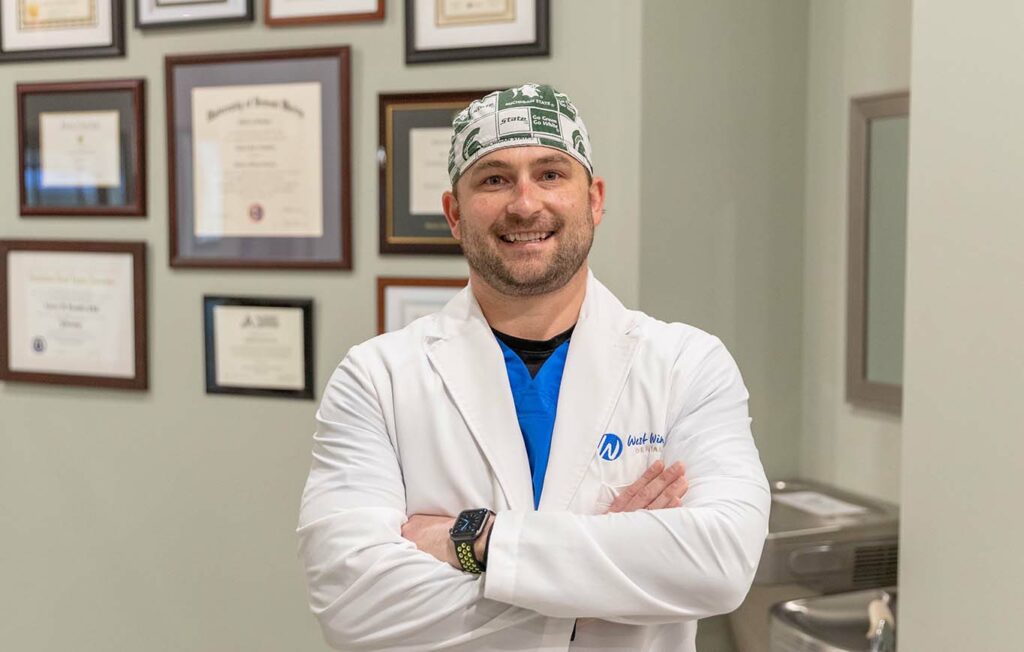
Dr. Hamilton is an active member of several professional organizations including the American Dental Association (ADA), the Michigan Dental Association (MDA), the Kalamazoo Valley District Dental Society (KVDDS), the American Academy of Implant dentistry (AAID), the International Academy of Facial Aesthetics (IAFA) and also attends courses with the Pikos Institute in Northwest Florida. He is a member of the International Congress of Oral Implantologists (ICIO), has achieved fellowship status in the International Dental Implant Association (IDIA) and in the Academy of General Dentistry (FAGD), has graduated from and is an alumnus of the Kois Center program in Seattle, and is on the faculty of the Global Dental Implant Academy (GDIA).
The little spare time left over is spent Steelhead and Salmon fishing and the occasional round of golf.